



Course Experience Survey
The Course Experience Survey (CES) is LSU's university-wide student feedback instrument for credit-bearing courses. Designed to provide meaningful insight into the student learning experience, CES offers a consistent framework for gathering feedback that supports reflection, continuous improvement, and informed decision-making across the institution.
This Knowledge Hub serves as a central resource for faculty, department leaders, and academic units navigating the Course Experience Survey process. Here, you can:
- Explore CES fundamentals, including its purpose, policies, and administration.
- Develop effective custom prompts through guidance, examples, and best practices for department-level customization.
- Interpret and apply results thoughtfully using strategies for understanding CES reports and leveraging student feedback to support continuous improvement.
Whether you're learning about CES for the first time or preparing to develop department-level custom prompts, this resource is designed to help you make informed decisions and get the most value from the Course Experience Survey.
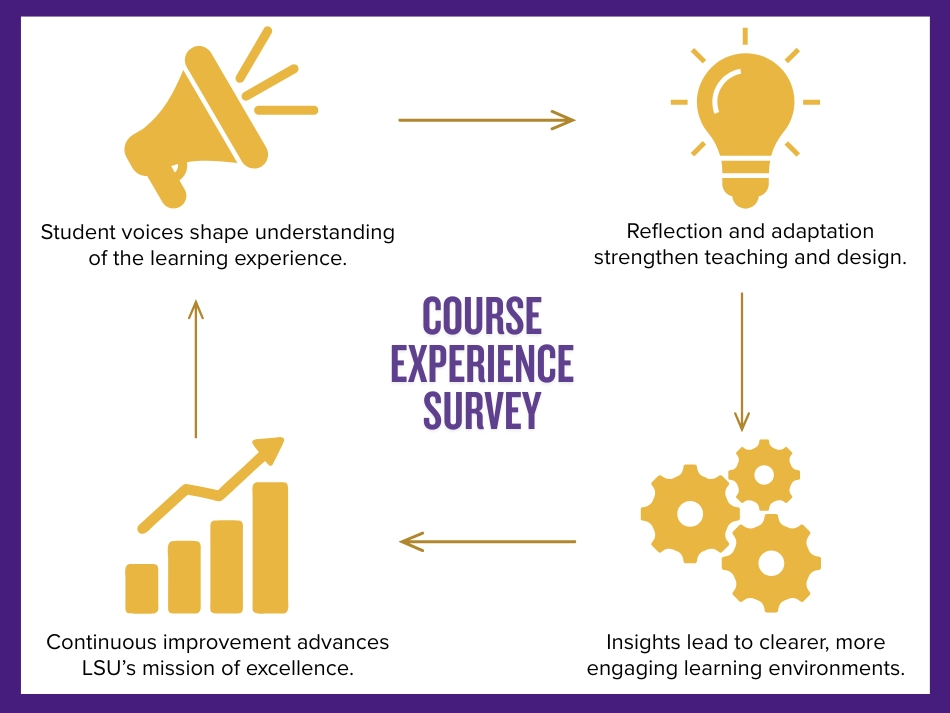
The CES Approach
The Course Experience Survey (CES) is designed to provide meaningful, actionable insight into the student learning experience while maintaining a consistent framework across the university. Its approach is guided by four key principles:
A Consistent University Framework.
Every eligible course includes LSU's standard core prompt set, providing a shared foundation for understanding the student learning experience across colleges and departments while supporting meaningful interpretation of results.
Thoughtful Customization.
In addition to the standard core, colleges and departments may develop approved custom prompts that reflect their unique instructional priorities and disciplinary context. This approach balances consistency with academic flexibility.
Meaningful, High-Quality Feedback
CES is intentionally designed to prioritize quality over quantity. A focused survey helps reduce survey fatigue, encourages thoughtful participation, and produces feedback that is more meaningful and actionable.
Reflection and Continuous Improvement
CES is intended to support instructor reflection, course enhancement, and broader academic review processes. Student feedback is most valuable when considered alongside other sources of evidence and interpreted within the context of the course.
Contact Us
Tara Rose
Associate Vice Provost
225-578-4915
Lee Daigle
Evaluation & Engagement Manager
225-578-5638
Questions & Support
Student feedback provides one perspective on the learning experience and can help identify opportunities to strengthen course design, clarify expectations, and improve instruction. The Course Experience Survey exists to provide faculty and departments with structured, consistent feedback that supports reflection and continuous improvement.
The Course Experience Survey (CES) is LSU’s standard end-of-course student feedback instrument for credit-bearing courses. It establishes a common university-wide framework for gathering student perspectives on the course experience while allowing limited customization at the college and department levels.
The CES consists of a set of standard core prompts that are administered consistently across eligible courses, along with approved custom prompts that may be added by colleges and departments to address discipline-specific priorities. This balanced approach promotes consistency and comparability across the university while preserving flexibility where it is most meaningful.
By providing a shared foundation for collecting student feedback, the CES supports a more coordinated, transparent, and equitable approach to understanding the student course experience across LSU.
The Course Experience Survey (CES) is designed to gather student perspectives on aspects of the course and learning experience that students are well positioned to observe and reflect upon. Its primary focus is understanding how course design and instruction influence learning and engagement.
The standard core prompts are intentionally broad, measuring shared elements of the student experience such as course structure, clarity of expectations, and learning. Colleges and departments may complement this common foundation with approved custom prompts that address discipline-specific priorities while maintaining consistency across the university.
By focusing on broad, student-centered experiences, the CES provides meaningful and actionable feedback that can support instructor reflection, departmental conversations, and continuous improvement.
The Course Experience Survey (CES) is intentionally designed to balance university-wide consistency with discipline-specific flexibility.
A shared set of standard core prompts provides a common foundation for gathering meaningful student feedback across LSU. Using the same core prompts and response scale helps ensure that feedback is collected consistently and can be interpreted fairly across courses, departments, and colleges.
At the same time, CES recognizes that every discipline has unique priorities. Colleges and departments may supplement the standard core prompts with approved custom prompts that address their specific instructional goals and areas of interest.
By combining a common framework with thoughtful customization, CES provides meaningful, actionable feedback while supporting both institution-wide consistency and the diverse needs of LSU's academic programs.
The Course Experience Survey (CES) is designed to gather broad, end-of-course student feedback on the learning experience. Like any assessment tool, it is most effective when used for the purpose it was designed to serve.
If your goal is to collect a different type of information, another feedback mechanism may be more appropriate. Consider the following:
Want broad, end-of-course feedback on the student learning experience?
Use: Course Experience Survey (CES)
Want to ask questions unique to your discipline across multiple courses?
Consider: Developing approved department-level custom prompts within the Course Experience Survey.
Want feedback on a specific assignment or classroom activity?
Consider: An instructor-developed survey or classroom feedback activity.
Want to make changes before the semester ends?
Consider: Mid-semester feedback opportunities.
Need information for specialized accreditation?
Consider: Program- or accreditation-specific assessment instruments.
Want to assess program learning outcomes?
Consider: Department or program assessment processes.
Student feedback collected through the Course Experience Survey (CES) contributes to a broader understanding of the course experience and serves as one source of information that can support reflection and continuous improvement.
At the instructor level, CES results provide insight into how students experienced the course and may help identify strengths as well as opportunities to refine course design or instruction.
Departments and colleges may review aggregated results and trends to inform conversations about teaching, curriculum, and the student learning experience within their academic units.
Like any source of feedback, student perspectives are most valuable when considered alongside other forms of evidence and within the context of the course, discipline, and instructional environment.
The Course Experience Survey (CES) combines a common university-wide framework with limited customization at the college and department levels.
All eligible courses include LSU's standard core prompts. In addition, colleges may add up to four approved custom prompts and departments may add up to six approved custom prompts that reflect their unique instructional priorities. If a college chooses not to use its full allocation, unused prompts may be made available to departments in accordance with university policy.
This approach balances consistency across the university with the flexibility needed to gather meaningful, discipline-specific feedback.
Every Course Experience Survey (CES) includes LSU's standard core prompts. These institution-wide prompts provide a common foundation for gathering consistent, meaningful feedback across courses and academic units while supporting fair interpretation of results.
The current standard core prompts are:
- The course was structured to support learning.
- The course expectations were clear.
- The course expanded my knowledge of this subject.
These prompts are required for all eligible CES course sections and may not be modified.
In addition to LSU's standard core prompts, colleges may include up to four approved custom prompts that reflect priorities shared across the college.
College custom prompts are intended to gather feedback on aspects of the student learning experience that are meaningful across multiple departments or programs within the college. Prompt development should be coordinated with departments to avoid duplication and maintain a reasonable overall survey length.
If a college elects not to use its full allocation of four prompts, the unused prompts may be made available to departments in accordance with university policy.
Example: A College of Engineering may choose to include a college-wide prompt related to design thinking or professional preparedness that is relevant across all of its academic programs.
Department custom prompts allow academic units to gather feedback on discipline-specific aspects of the student learning experience that are not addressed by LSU's standard core prompts.
Departments may include up to six approved custom prompts. If a college chooses not to use its full allocation of college-level prompts, unused prompts may be made available to departments in accordance with university policy.
Departments are encouraged to develop prompts that are meaningful across their curriculum, actionable, and aligned with their instructional priorities.
Examples:
The Department of Communication Studies may choose to include a prompt about students' opportunities to practice and develop effective oral communication skills.
The Department of Biological Sciences may choose to include a prompt about students'
opportunities to apply scientific inquiry or analyze experimental data.
The Department of History may choose to include a prompt about students' ability to
critically analyze and interpret primary sources.
The Course Experience Survey (CES) is designed to provide meaningful, high-quality feedback while respecting students' time and attention. For this reason, the number of custom prompts available to colleges and departments is intentionally limited.
As surveys become longer, students are more likely to experience survey fatigue, which can reduce completion rates and lead to less thoughtful responses. By encouraging departments to focus on the questions that matter most, CES helps ensure that the feedback collected is relevant, actionable, and of the highest possible quality.
Prompt limits also preserve a common university-wide framework, allowing departments to gather discipline-specific information while maintaining consistency across LSU.
A smaller set of well-designed prompts often produces more meaningful insights than a longer survey with overlapping or low-priority questions. By encouraging departments to focus on the questions that matter most, the Course Experience Survey (CES) helps ensure that the feedback collected is relevant, actionable, and of the highest possible quality.
The number of custom prompts available to colleges and departments is intentionally limited to reduce survey fatigue and encourage thoughtful student participation. As surveys become longer, students are more likely to disengage, resulting in lower completion rates and less reliable feedback.
Prompt limits also preserve a common university-wide framework, allowing departments to gather discipline-specific information while maintaining consistency across LSU.
Well-designed survey prompts are more likely to produce meaningful, actionable feedback. When developing custom prompts, departments should strive for questions that are:
Clear – Students should understand what is being asked without additional explanation.
Specific – Each prompt should focus on a single concept or idea.
Relevant – Students should be asked about experiences they are reasonably able to observe
and evaluate.
Actionable – Responses should provide information that can support reflection or inform future
improvements.
Neutral – Prompts should avoid language that suggests or encourages a particular response.
Keeping these principles in mind helps ensure that custom prompts generate feedback
that is both useful and reliable.
A double-barreled question asks about two different ideas but allows students to provide only one response. This can make it difficult to understand what the response actually reflects.
Example of a double-barreled prompt:
The course provided opportunities to apply concepts to real-world situations and collaborate effectively with peers.
A student may agree that the course emphasized real-world application but disagree that it encouraged collaboration, making it impossible to know which aspect influenced their response.
A stronger approach is to separate the concepts into individual prompts:
The course provided opportunities to apply concepts to real-world situations.
The course provided opportunities to collaborate effectively with peers.
Whenever possible, each survey prompt should focus on a single idea to produce clearer,
more interpretable, and more actionable results.
Leading language suggests or encourages a particular response rather than inviting students to share their honest perspectives. As a result, responses may reflect the wording of the prompt rather than the student's actual experience.
Example of a leading prompt:
The course provided valuable opportunities to apply concepts to real-world situations.
The word valuable implies a positive judgment and may influence how students respond.
A more neutral approach is:
The course provided opportunities to apply concepts to real-world situations.
When developing custom prompts, avoid words that imply approval or assume a particular outcome. Neutral language produces more objective and actionable feedback.
Actionable prompts gather feedback that can inform meaningful reflection or improvement. Before including a custom prompt, departments should consider whether the responses will help guide future decisions about the curriculum or student learning experience.
Less actionable:
The course was intellectually stimulating.
While students may have different interpretations of "intellectually stimulating," the responses provide little guidance about what should be maintained or improved.
More actionable:
The course encouraged consideration of ethical issues relevant to the discipline.
Responses to this prompt provide clearer information that departments can use to evaluate whether students perceive opportunities to engage with ethical reasoning in the curriculum.
When developing custom prompts, ask whether the results will provide information that can meaningfully inform future action.
The Course Experience Survey (CES) is administered for eligible credit-bearing courses with an identified Instructor of Record (IOR) in Workday.
In general, CES applies to:
- Undergraduate and graduate courses numbered below 8000 that meet enrollment and timing criteria.
- Lecture courses.
- Laboratory and studio courses.
- Seminar courses.
Courses such as recitations, practicums, clinicals, internships, independent studies, research studies, and courses numbered 8000 and above are excluded from CES administration.
Course Experience Surveys (CES) are administered near the end of the academic term.
For most full-semester courses, surveys typically open two weeks before final exams. For seven-week courses, surveys typically open one week before final exams. Surveys generally close on the day of or the day before the scheduled final exam.
Survey dates vary by semester and are published on the first day of classes for the applicable term.
In team-taught courses, department-level custom prompts related to instructor effectiveness may be presented separately for each Instructor of Record (IOR). As a result, students in courses with multiple instructors may receive more survey prompts than students in single-instructor courses.
When developing or revising custom prompt sets, departments should be mindful of the cumulative survey length and prioritize prompts that are essential, non-duplicative, and actionable. Keeping surveys concise helps reduce survey fatigue and supports thoughtful student participation.
For purposes of the Course Experience Survey (CES), the Instructor of Record (IOR) is the individual identified as the instructor of the course section in Workday.
Only course sections with an identified Instructor of Record are eligible for CES administration. Teaching Assistants (TAs) will not receive a CES unless they are designated as the Instructor of Record in Workday.
Course Experience Survey (CES) results are made available to faculty the day after grades are due.
Providing results after grade submission helps preserve the integrity of the evaluation process by ensuring that student feedback is collected independently of final grade posting.
Process Currently Being Developed. Stay Tuned.
The CES Faculty Handbook provides the official policies and procedures governing the Course Experience Survey, including course eligibility, administration timelines, custom prompt policies, reporting practices, and interpretation guidance.
Download the CES Faculty Handbook (PDF)
Course Experience Survey (CES) results provide insight into students' perceptions of their course experience and are intended to support reflection and continuous improvement.
CES results should be interpreted alongside other relevant sources of evidence, such as peer review, self-reflection, course materials, assignments, and additional indicators of teaching and learning.
The most meaningful insights often emerge from patterns rather than individual data points. When reviewing results, consider trends across multiple prompts, written comments, and repeated course offerings instead of focusing on a single score or isolated response.
Course Experience Survey (CES) reports provide both quantitative and qualitative feedback to help instructors and academic units better understand the student learning experience.
CES reports include:
- Item-level results for each survey prompt.
- The mean, median, and standard deviation for each prompt.
- The distribution of student responses across the response scale.
- The number of student respondents.
- Written comments submitted by students.
- Benchmark comparisons.
Each element provides a different perspective on the student experience and should be considered together rather than in isolation.
The mean provides a useful summary of student responses, but it does not tell the whole story. Two courses can have the same mean while reflecting very different patterns of student feedback.
When interpreting CES results, consider the mean alongside the median, response distribution, standard deviation, written comments, and the context of the course. Looking at multiple sources of information provides a more complete understanding of the student experience than any single statistic alone.
Rather than focusing on a specific score, look for consistent patterns that can help identify strengths and opportunities for improvement.
The response distribution shows how students answered each survey prompt across the available response options. Reviewing the distribution can help you determine whether students had a shared experience or whether perceptions varied across the class.
For example, two courses may have the same mean score but very different response distributions. One course may have responses clustered around a single rating, while another may have responses spread across the scale, reflecting a wider range of student experiences.
When interpreting CES results, review the response distribution alongside the mean, median, standard deviation, written comments, and course context to develop a more complete understanding of the feedback.
Benchmark comparisons provide context by allowing instructors and academic units to compare mean scores with department-, college-, or university-level results. They should be used as reference points rather than as stand-alone indicators of teaching effectiveness.
Small differences in benchmark scores may not be practically meaningful and should be interpreted alongside item-level results, response distributions, written comments, course context, and other relevant sources of evidence.
The most meaningful use of benchmarks is to support reflection and identify opportunities for continuous improvement rather than to rank courses or instructors.
Written comments can provide valuable context for quantitative results and may help explain patterns observed in survey responses. When reviewing comments, look for recurring themes rather than focusing on individual statements.
A single comment may reflect one student's unique experience or perspective. When similar observations appear across multiple comments or align with quantitative results, they may indicate an opportunity for reflection or improvement.
Comments are most meaningful when considered alongside the full range of CES results and other relevant sources of evidence.
A single Course Experience Survey (CES) administration provides a snapshot of students' perceptions during one offering of a course. Reviewing results across multiple semesters or sections can help identify recurring strengths, persistent concerns, and the impact of changes made over time.
When interpreting trends, consider the context of each course offering, including changes in enrollment, instructional modality, course design, or other relevant factors that may influence student feedback.
Looking for patterns over time provides a more meaningful basis for reflection and continuous improvement than relying on the results of a single survey.
Course Experience Survey (CES) results are intended to support instructor reflection, course improvement, and broader academic review processes. Access to CES results is provided in accordance with university policy.
The Office of Institutional Effectiveness (OIE) administers and manages the CES process but does not use survey results to evaluate instructors or make personnel decisions. OIE's role is to steward the survey instrument, support its effective implementation, and help ensure that colleges and departments can make meaningful use of student feedback.
CES results should be interpreted responsibly and in conjunction with other relevant sources of evidence, consistent with the university's commitment to continuous improvement.
Students are more likely to complete the Course Experience Survey (CES) when they understand its purpose and believe their feedback will be used to support meaningful improvement.
Faculty can encourage participation by:
- Explaining how student feedback informs course and curricular improvements.
- Setting aside a few minutes during class to remind students to complete the survey.
- Emphasizing that thoughtful feedback is more valuable than simply completing the survey.
- Sharing examples of changes made in response to student feedback, when appropriate.
- Prioritizing only the most meaningful custom prompts to help reduce survey fatigue and encourage thoughtful participation.
Creating a culture in which students see the impact of their feedback—and are asked to respond to a focused, purposeful survey—can help support stronger participation and more meaningful responses.
Students are more likely to provide thoughtful feedback when they understand why the Course Experience Survey (CES) matters and how their responses can make a difference.
When introducing CES, consider emphasizing that:
- Your feedback helps improve future courses. Student responses can inform changes to course design, curriculum, and the overall learning experience.
- Honest feedback is the most valuable feedback. There are no right or wrong answers—thoughtful perspectives, whether positive or constructive, help instructors and academic units identify strengths and opportunities for improvement.
- The survey is about your experience. Students are encouraged to reflect on their own learning and engagement when responding.
- Every response contributes to a broader picture. Looking for patterns across many student responses helps instructors and departments make informed decisions over time.
Helping students understand the purpose and value of CES can encourage more meaningful participation and strengthen the culture of feedback across the university.
The Course Experience Survey (CES) provides valuable insight into students' end-of-course experiences. Many faculty also choose to gather feedback throughout the semester to identify concerns early, recognize what's working well, and make adjustments while learning is still in progress.
Faculty may choose to gather formative feedback through methods such as:
- Brief anonymous surveys.
- Mid-semester feedback questionnaires.
- Classroom discussions or facilitated feedback sessions.
- Short written reflections at the end of class.
- One-minute papers or other quick written activities.
Gathering feedback at multiple points throughout the semester can complement CES results, encourage open communication, and support continuous improvement.
The Course Experience Survey (CES) is designed to gather consistent, end-of-course feedback about the student learning experience across the university. While CES can provide valuable insights, it may not be the most appropriate tool for every type of feedback.
Depending on the information sought, faculty and academic units may also consider other approaches, such as:
- Mid-semester feedback questionnaires to identify opportunities for improvement during the course.
- Course-specific surveys to gather input on individual assignments, activities, or instructional innovations.
- Program- or accreditation-related surveys designed to meet specialized reporting or assessment needs.
- Focus groups or facilitated discussions to explore student perspectives in greater depth.
Selecting the right tool for the right purpose can help ensure that feedback is meaningful, actionable, and collected at the most appropriate time.
Course Experience Survey (CES) results offer valuable insight into students' perceptions of their course experience. Many faculty and academic units find the most meaningful understanding of teaching and learning emerges when student feedback is considered alongside other sources of evidence.
Additional sources of information may include:
- Peer review of teaching.
- Instructor self-reflection.
- Course materials and assignments.
- Evidence of student learning and achievement.
- Program-level assessment activities.
Considering multiple sources of evidence can provide a more comprehensive perspective, support informed decision-making, and identify opportunities for continuous improvement.
The Course Experience Survey (CES) is your opportunity to tell LSU about your experience in a course. At the end of each academic period, you'll be invited to share feedback about what helped you learn, what could be improved, and your overall experience in the course.
Your responses help instructors and academic units better understand the student experience and make informed decisions about future courses. By taking a few minutes to provide honest, thoughtful feedback, you help shape the learning experience for future Tigers.
Your feedback helps improve the student experience at LSU.
When you complete the Course Experience Survey (CES), you're sharing insights about what supported your learning and where there may be opportunities to improve. That feedback can help instructors, departments, and the university better understand what's working well and where changes may be needed.
Whether you had a great experience or think something could be better, your honest and thoughtful feedback helps shape future courses and supports a stronger learning environment for current and future students.
Your feedback helps LSU understand what's working well in the classroom and where there may be opportunities to improve.
When many students share their experiences, instructors and departments can identify common themes and use that information to make informed decisions about courses and the overall learning experience.
Even if you don't see changes right away, your feedback becomes part of an ongoing effort to create a better experience for current and future students.
Yes. The Course Experience Survey (CES) is designed to allow students to provide honest and candid feedback.
Instructors do not have access to information that identifies who submitted a particular response, and survey results are not released until after final grades have been submitted.
Your feedback is most valuable when it reflects your genuine experience, so we encourage you to answer thoughtfully and honestly.
No. Completing the Course Experience Survey (CES) and the feedback you provide will not affect your grade.
Survey results are not released to instructors until after final grades have been submitted. This allows students to share honest feedback without concern that their responses will influence their course grade.
We encourage you to provide thoughtful and constructive feedback based on your experience in the course.
Yes. Instructors receive written comments submitted through the Course Experience Survey (CES), but they do not receive information that identifies which student submitted a particular comment.
Written feedback can provide valuable context and help instructors better understand the student experience. When sharing comments, focus on your own experience and provide feedback that is honest, respectful, and constructive.
Most students can complete the Course Experience Survey (CES) in just a few minutes.
CES was intentionally designed to be concise and focused so you can provide meaningful feedback without spending unnecessary time answering repetitive questions. The exact length of your survey may vary depending on the number of courses you're taking and whether additional questions have been included for a particular course.
Taking a few minutes to share your experience can make a meaningful difference for future students.
When the Course Experience Survey (CES) opens, you'll receive an email with a link to complete your surveys.
If you log in to Moodle during the survey period, you'll also see a pop-up notification letting you know that your course surveys are available and providing quick access to complete them.
If you're enrolled in multiple eligible courses, you'll have the opportunity to complete a separate survey for each course.
The Course Experience Survey (CES) is available near the end of each academic period, before final exams.
When your surveys are ready, you'll receive an email notification. If you log in to Moodle during the survey period, you'll also see a pop-up notification with quick access to your available surveys.
Be sure to complete your surveys before they close so your feedback can be included.
Yes. The Course Experience Survey (CES) is mobile-friendly and can be completed on a smartphone, tablet, or computer.
Whether you access the survey through the email invitation or from Moodle, you can complete it using the device that's most convenient for you.
LSU redesigned its course evaluations to make them more focused, more meaningful, and easier for students to complete.
The Course Experience Survey (CES) uses a concise set of questions centered on the learning experience rather than asking students to respond to long or repetitive surveys. The goal is to make it easier for students to provide thoughtful feedback while giving instructors and academic units clearer insights that can support future improvements.
In short, CES was designed to make your feedback more meaningful—and your time more valuable.