



Team Blending Fashion and Engineering to Design a High-Tech Exoskeleton for Construction Safety
February 19, 2026
In a scene that seems straight out of a sci-fi movie, LSU doctoral candidate Mary-Gwynedd Taylor pulls a part out of a 3D-printer to assemble a sturdy three-dimensional leg brace fit for a bionic man — or woman.
“See this hinge, here?” Taylor points to the housing of a rotary actuator (a motor that mimics the movement of a joint such as the knee) at the midpoint of the leg brace. “This piece of our exoskeleton is powered so that as your leg begins to fatigue, it adds resistance and makes squatting and lifting easier, preventing injury.”
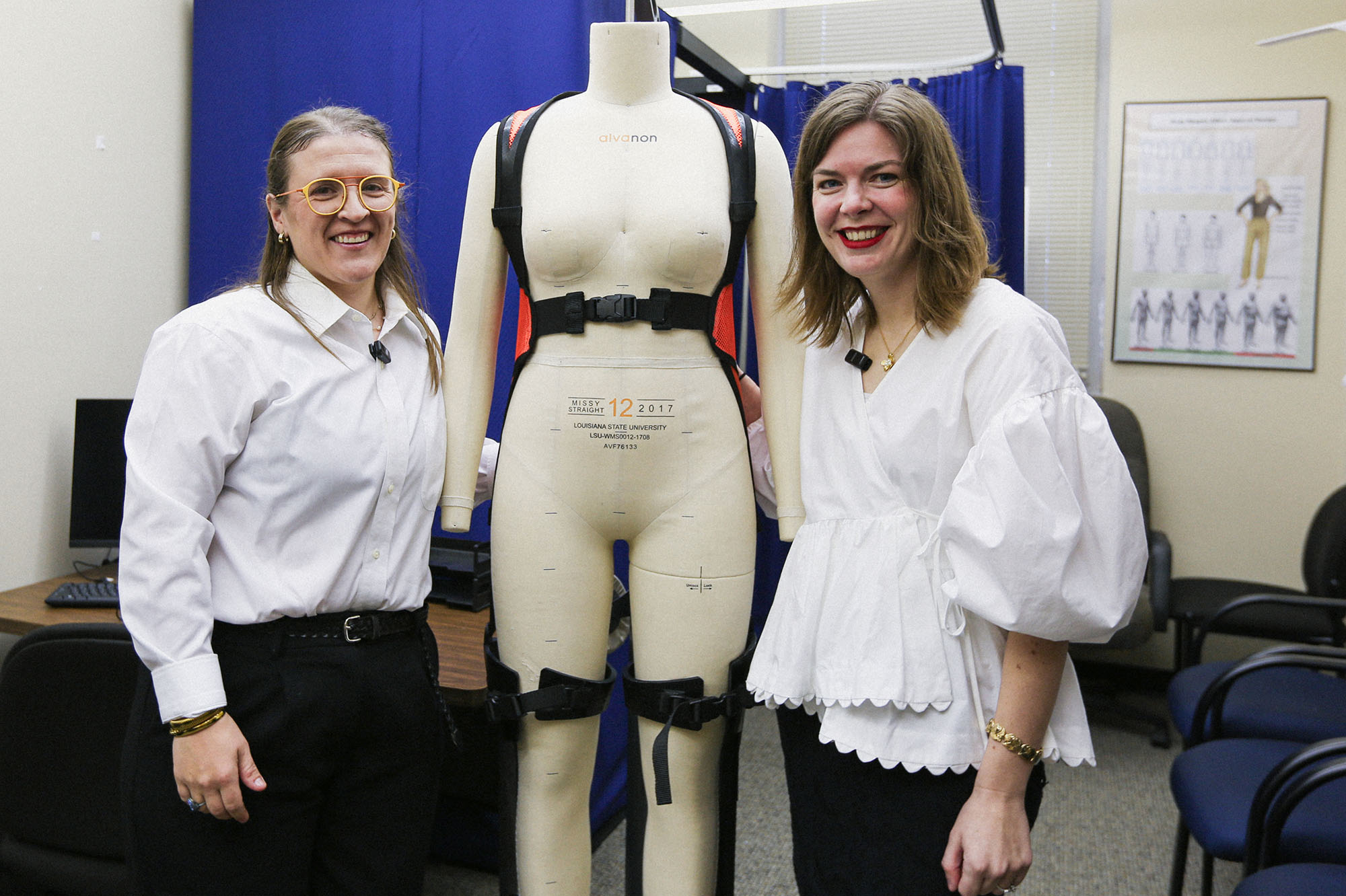
M-G Taylor, LSU apparel design doctorate candidate, and Casey Stannard, the Beverly Griffin Shea Associate Professor of Apparel Design in the LSU College of Agriculture, with a wearable exoskeleton prototype.
The U.S. construction industry’s need for labor is soaring, driven by a shortage of construction workers and a boom in demand for artificial intelligence infrastructure. An aging, retiring construction workforce means the industry needs to attract new talent. Smart wearables might be the key.
Construction workers, including an increasing number of women, face challenges that can limit their participation and longevity in the industry, including injuries and poorly fitting personal protective equipment (PPE).
A collaborative research team at LSU—including experts in fashion, textiles, ergonomics, engineering, and computer science—is looking to address these problems for both male and female construction workers. Their solution: a smart, wearable exoskeleton.
Projection Against Injury
In research funded by the National Science Foundation as part of a Future of Work program, researchers in construction management and industrial engineering from LSU and Rutgers, including project lead and LSU researcher Chao Wang, have been working to develop a wearable exoskeleton to protect wearers from acute and repetitive strain injuries.
The researchers plan to embed sensors into the exoskeleton and train it using machine learning models to support specific movement tasks and adapt on the spot. But when it came to designing an exoskeleton that could fit a variety of body shapes flexibly, comfortably, and safely, the team needed more than engineering expertise. They needed fashion and apparel design experts.
“Exoskeletons often suffer from the same shortcomings as other PPE offerings, particularly the lack of adjustability to accommodate the anatomical differences” of workers, Taylor writes in a paper published in the 2025 International Textile and Apparel Association Annual Conference Proceedings.
Taylor and Dr. Casey Stannard, the Beverly Griffin Shea Associate Professor of Apparel Design in the LSU College of Agriculture, joined the exoskeleton engineering team to design a harness to house the rotary actuator exoskeleton.
Taylor and Stannard are currently focused on optimizing the exoskeleton housing for the female construction worker form and plan to expand to fit male forms in future design iterations.
“In the construction industry, all parties involved on a site need to be wearing PPE that needs to fit well and identify them through bright colors,” Taylor said.
Taylor began prototyping for the exoskeleton harness in a 3D fashion design software program called CLO-3D. The harness had to fit various needs: ergonomic body positioning, close-to-body fit along the legs for sensor accuracy, housing for the exoskeleton battery, and easy removal.
Some areas of the harness need to stretch, such as the shoulder and hip straps, while the leg braces need to be made of a hard material so that the exoskeleton sensors and motors can work properly.
A Multi-Disciplinary Solution
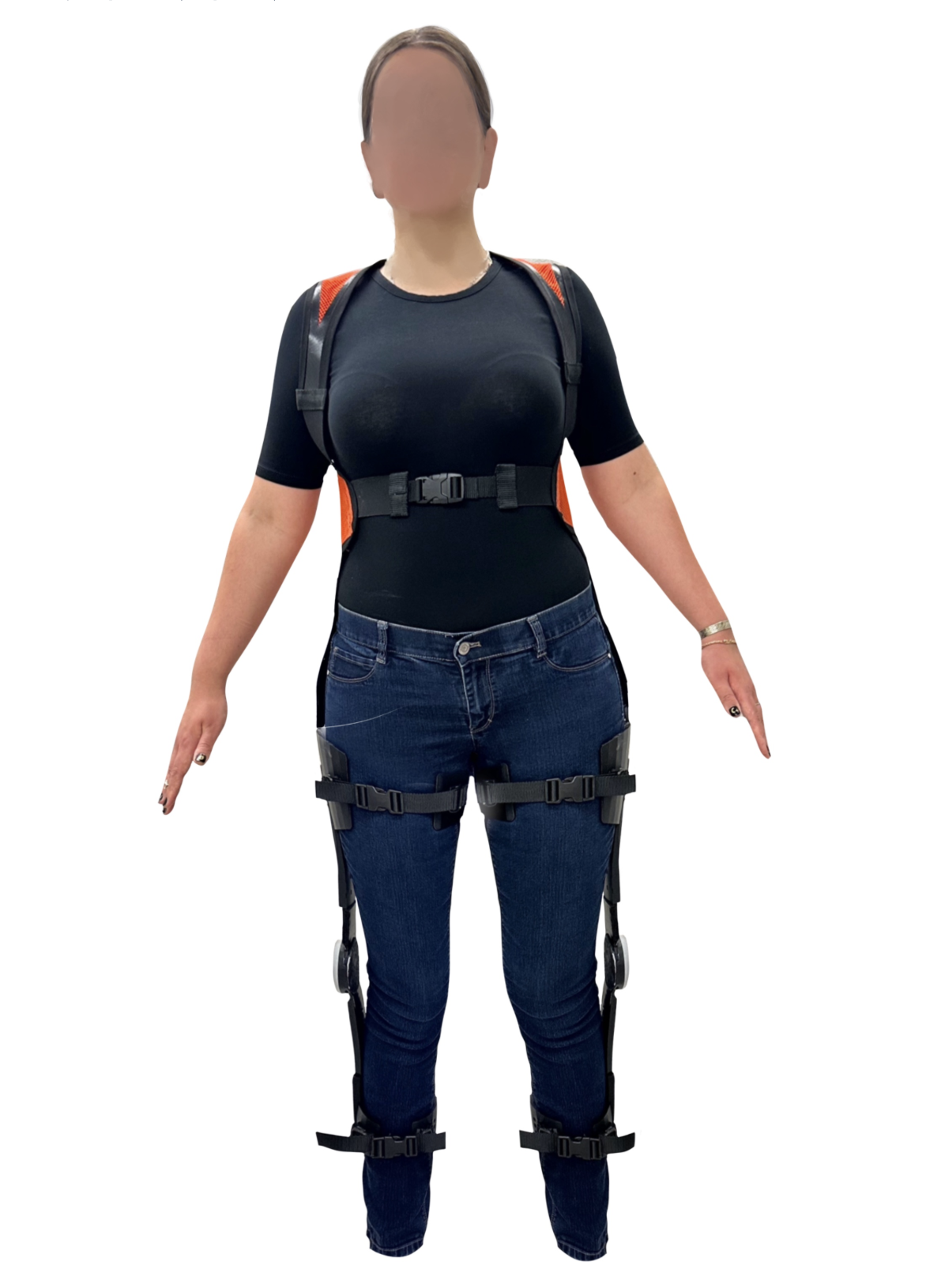
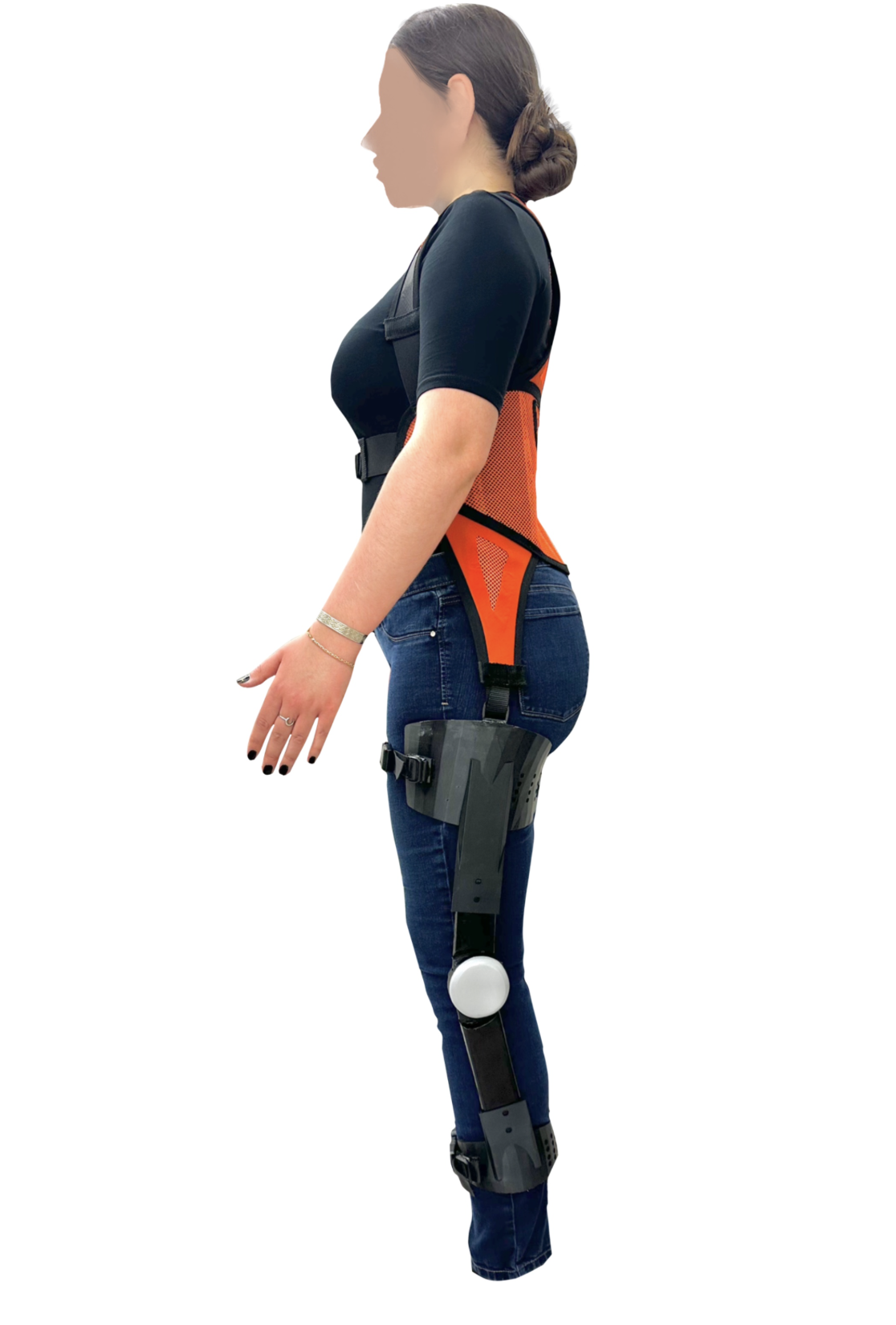
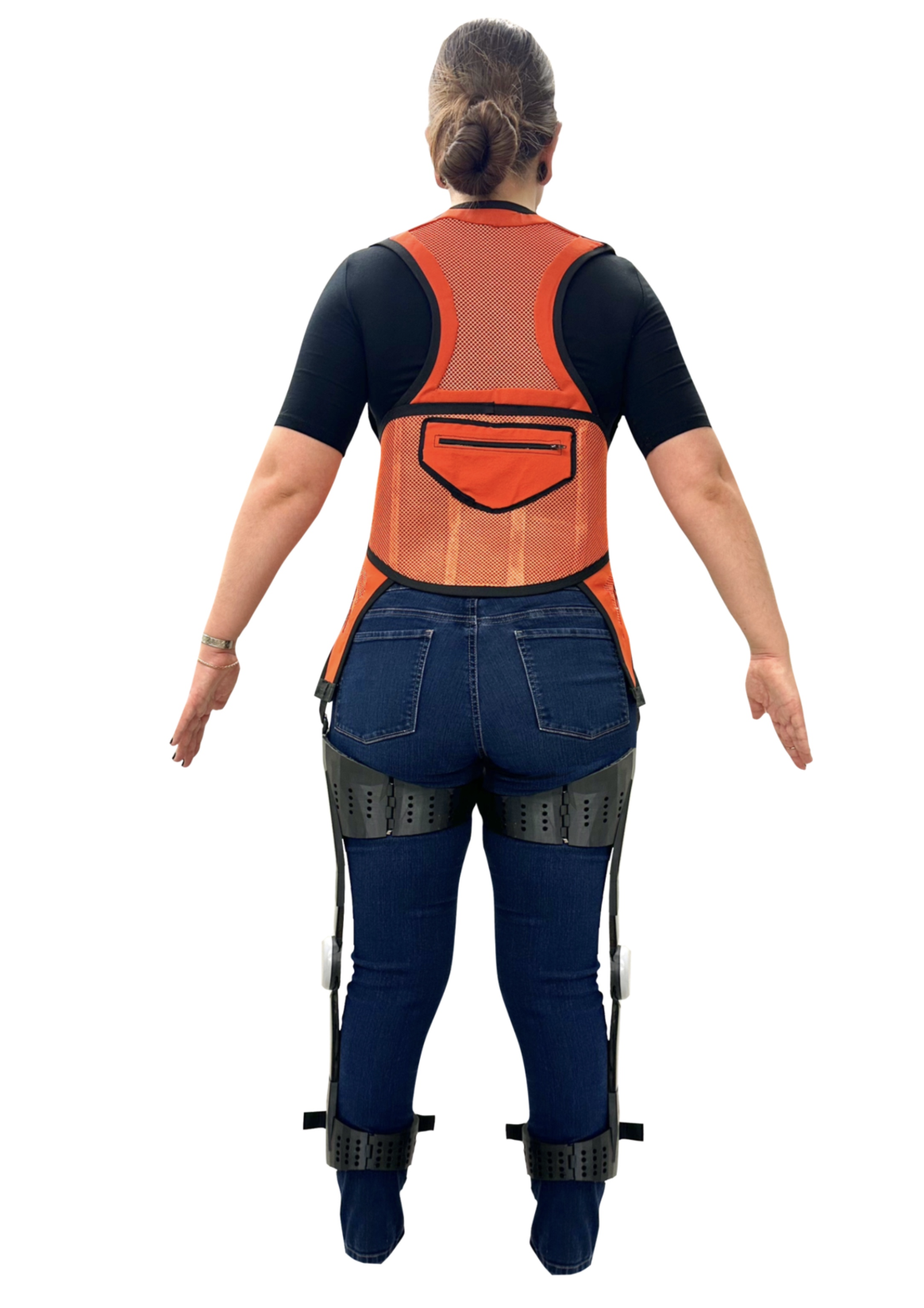
Taylor and team went through several iterations of the exoskeleton harness, refined through fit testing. The current iteration uses a neon orange fabric, a stretchy backpack-like upper body construction, and dark-colored, rigid, 3D-printed leg braces with aeration holes for breathability.
A mesh panel on the mid-back provides airflow where users sweat most. Padded straps come over the shoulders and curve away from the chest to improve comfort and fit. This is critical, as ill-placed harness straps can cause serious “seatbelt injuries” and trauma.
A semirigid back panel supports the lower back and wraps around the waist, distributing the exoskeleton's weight over the trunk of the body. This panel features a back pocket for the exoskeleton's battery and processor, with a zipper for easy access.
“This exoskeleton harness is a good example of a project investigating a ‘wicked problem’ or a problem that is multi-disciplinary, complex, and human-centered,” Stannard said. “In apparel design, we really enjoy working on these types of problems that require bringing together various fields of expertise. We are huge fans of collaboration.”
The next step of the project will involve human trials and testing to ensure the exoskeleton harness fits well and works as intended.
Read the paper: Work-Assist Exoskeleton Harness for Female Construction Workers
Discover stories showcasing LSU’s academic excellence, innovation, culture, and impact
across Louisiana.Next Step